






















Home
The Coffin of Andy and Leyley
The Coffin of Andy and Leyley: Survival as a Shared System
Jump to the play area, read the introduction, and open the FAQ for this browser horror game page.
Gameplay Videos
Playing The Coffin of Andy and Leyley from the First Decision
The Coffin of Andy and Leyley begins as a psychological horror adventure where siblings Andrew and Ashley survive confinement by relying on a relationship that is resourceful, resentful, manipulative, and increasingly destructive. Its opening is effective because it does not separate story from interaction: the first routine, answer, or observation already teaches the player what this world values. A sealed apartment gives way to rooms shaped by scarcity, family memory, occult danger, and the consequences of decisions that cannot be made morally clean gives the experience a clear visual identity while leaving enough uncertainty for familiar details to become suspicious. The result is a browser game that rewards deliberate attention before it rewards confident action.
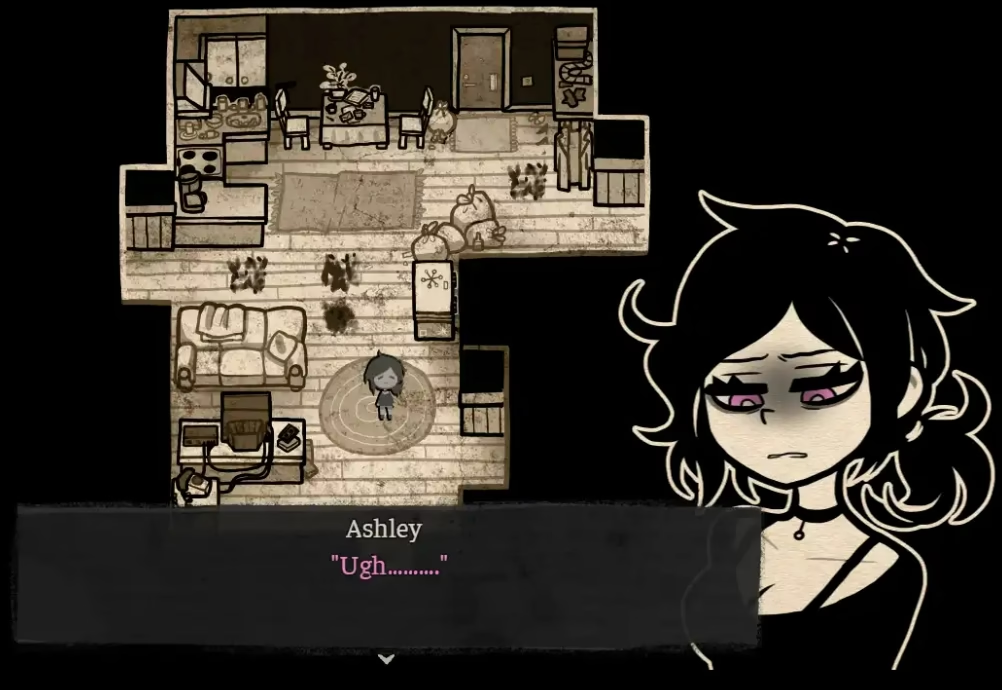
Launch the embedded build above and allow its remote assets to finish loading before refreshing. The central activity is exploring compact environments, collecting useful objects, reading visual clues, solving situational puzzles, and following dialogue choices that expose competing versions of responsibility. Controls are easy to learn, but understanding consequence takes longer because the interface can describe an action more simply than the story ultimately judges it. Read labels, reactions, and changes in atmosphere together rather than assuming one visible number or expression contains the complete result.
This Cobb Can Move guide uses a systems-focused angle. Andrew and Ashley, two capable survivors whose shared history lets them solve immediate problems while preventing either one from establishing a stable boundary is not only a plot figure; that character reveals what the game's rules consider normal. cooperation improves the siblings' chance of surviving the next room while reinforcing the dependency that makes a safer future harder to imagine. Following that tension makes the route easier to interpret and gives the first ending value even when it is not the outcome the player expected.

The Rules Tell Their Own Story
Every game system makes an argument about what deserves attention. Menus emphasize some resources and hide others, objectives define what counts as progress, and feedback teaches which consequences should feel important. In The Coffin of Andy and Leyley, those priorities are part of the fiction. The player should therefore ask who benefits from the current definition of success and which human cost remains outside the visible interface.
A useful first route follows one principle. Prioritize stability, curiosity, empathy, efficiency, honesty, or self-protection, then keep that principle recognizable across several scenes. Consistency creates a route that can be evaluated. Constantly selecting whichever option produces immediate approval may avoid local discomfort while making the protagonist's overall behavior impossible to understand.
Notice when the game changes terminology without changing the underlying action. A harmful choice can sound reasonable after it receives an administrative label, while a protective choice can appear inefficient when the system measures only short-term output. These wording shifts are narrative clues. They show how authority attempts to move responsibility away from the person designing the rules.
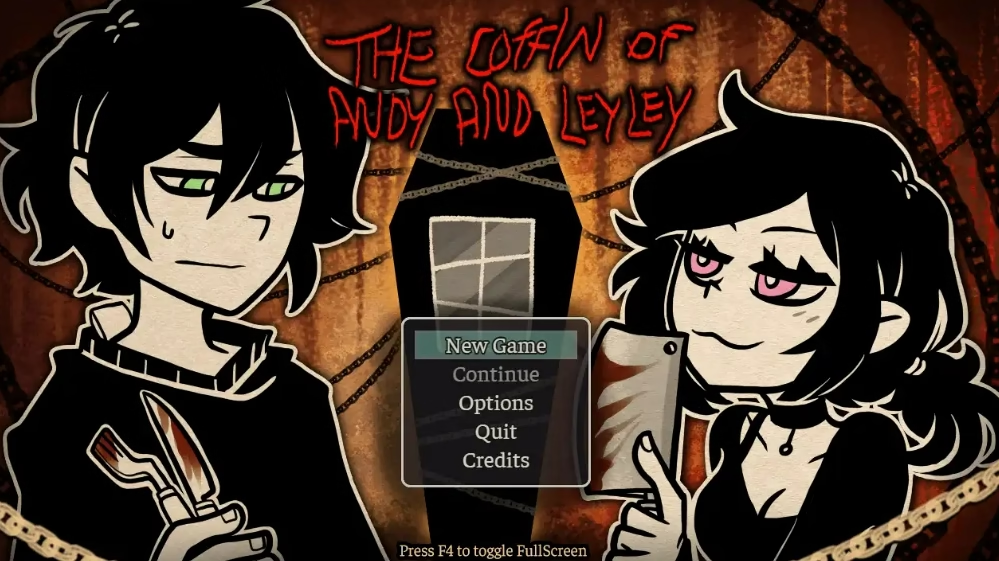
Understanding Andrew and Ashley, two capable survivors whose shared history lets them solve immediate problems while preventing either one from establishing a stable boundary
Andrew and Ashley, two capable survivors whose shared history lets them solve immediate problems while preventing either one from establishing a stable boundary should be read through patterns instead of a single dramatic moment. Watch what creates comfort, what triggers resistance, and what the character cannot say directly. A reaction may reflect the current choice, accumulated treatment, or fear of what the system permits next. Treating every response as a score makes these overlapping motives disappear.
The strongest interactions preserve contradiction. Affection can coexist with control, cooperation with resentment, and apparent safety with a growing loss of agency. cooperation improves the siblings' chance of surviving the next room while reinforcing the dependency that makes a safer future harder to imagine. The story becomes more compelling when the player recognizes that sincerity does not automatically make a relationship or institution harmless.
Do not chase maximum approval on the first run. Let the protagonist maintain a point of view and observe what that costs. A relationship has more narrative meaning when two positions remain visible than when the player becomes whatever another character appears to want. This also makes later route changes easier to identify because the original strategy had a stable emotional baseline.
A Practical First-Run Strategy
Before each important action, name its function. Is the player gathering information, offering reassurance, spending a limited resource, accepting a premise, or challenging control? This short pause prevents attractive wording from hiding what the choice actually does. It also helps separate a tactical sacrifice from a compromise that changes the protagonist's identity.
Avoid restarting immediately after an uncomfortable result. Consequences provide information, and later scenes may revise the apparent meaning of a mistake. A blind first ending records how you understood the game without outside optimization. That record becomes the best starting point for a replay because it reveals which assumption deserves a controlled test.
Use fullscreen when reading dense text or inspecting small visual changes. On mobile, landscape orientation offers more room for controls. Click inside the iframe if keyboard input or audio does not begin, since browsers often require a user gesture before an embedded game receives focus. These setup steps reduce technical interruptions without changing the route itself.
Replay Without Turning the Story into a Checklist
After an ending, write a compact route summary: the protagonist's priority, the most important relationship, the system's strongest point of leverage, and the choice whose consequence surprised you. Four observations are enough. Recording every click can replace interpretation with bookkeeping and make a second run feel like data entry rather than discovery.
Return to one argument or practical decision and trace which earlier compromise made that outcome feel inevitable. Keep other decisions stable until the consequence becomes visible. Controlled comparison helps distinguish one branch flag from an accumulated pattern of behavior. It also reveals whether the game responds to what the player did, why the player appeared to do it, or how consistently that motive was expressed.
Compare endings by cost, not only by labels such as good or bad. Ask what remains of autonomy, trust, memory, resources, and responsibility. An apparently successful conclusion may validate the system that created the danger, while a difficult ending may preserve an important truth. This broader accounting gives route discussion more depth than treating the final screen as a simple score.
How Presentation Shapes Judgment
A sealed apartment gives way to rooms shaped by scarcity, family memory, occult danger, and the consequences of decisions that cannot be made morally clean controls the player's expectations before the story explains its conflict. Color, framing, interface language, and repeated spaces suggest what should feel ordinary. Once that baseline is established, one changed detail can become more disturbing than an entirely new scene. Visual consistency therefore supports suspense rather than limiting it.
Sound and pacing guide attention in similar ways. A pause can expose a decision that energetic music previously made easy to accept. A familiar cue can become threatening after the player learns what follows it. Headphones help reveal quiet transitions, but comfortable volume is more important than maximum immersion, especially when the game uses unsettling audio.
Presentation can also become an alibi. Cheerful design, domestic warmth, efficient dashboards, or nostalgic imagery may encourage the player to excuse what would appear cruel in a neutral frame. The game asks whether attractive language changes an action or merely changes how quickly the player agrees to perform it.
Browser Loading and Save Protection
The iframe depends on a remote game host, so a page can load while the game itself still needs time. If the frame remains black, wait briefly, refresh once, and inspect privacy extensions that block scripts, storage, media, or third-party frames. Repeated refreshes can restart asset downloads and make a slow connection appear permanently broken.
Modern desktop browsers generally provide the most reliable experience. Older phones may run out of memory when several tabs remain open, and managed school or office networks may filter the external host. Closing unused tabs or trying another connection can help. The website cannot override a network rule that blocks the game's domain.
Progress may use local browser storage. Clearing site data, changing profiles, using private mode, or moving to another device can create a fresh save. Keep short route notes outside the player when planning multiple endings. Do not clear storage as a first troubleshooting step unless losing progress is acceptable.
Themes and Player Comfort
The Coffin of Andy and Leyley centers cooperation improves the siblings' chance of surviving the next room while reinforcing the dependency that makes a safer future harder to imagine. It contains violence, death, criminal behavior, coercive family dynamics, cannibalism references, disturbing imagery, and mature psychological horror. These subjects can feel more immediate when they appear through routine interaction rather than distant exposition. A humorous, colorful, or welcoming surface does not necessarily indicate light content; contrast is often how the game makes its darker argument visible.
Take breaks when a route becomes uncomfortable. Narrative horror works best when players retain control over when and how they engage. Leaving fullscreen, lowering sound, or returning later is a valid way to preserve the distance needed for interpretation. Completion is not more important than comfort.
At a deliberate pace, the game becomes a study of how systems and relationships define value. The player is asked not only to survive or reach an ending, but to identify which assumptions made the danger appear normal. That question remains useful after individual surprises are known and gives replay a purpose beyond collecting scenes.
The Coffin of Andy and Leyley FAQ
What is The Coffin of Andy and Leyley?
The Coffin of Andy and Leyley is a psychological horror adventure where siblings Andrew and Ashley survive confinement by relying on a relationship that is resourceful, resentful, manipulative, and increasingly destructive.
Can I play The Coffin of Andy and Leyley online?
Yes. Press Play above to launch the browser build inside the embedded game frame.
Does the game require a download?
No separate download is required for this page, although the remote assets still need time to load.
Do decisions affect the route?
Yes. Decisions involving exploring compact environments, collecting useful objects, reading visual clues, solving situational puzzles, and following dialogue choices that expose competing versions of responsibility can change relationships, available information, resources, and endings.
What is the best first strategy?
Choose one coherent priority, read reactions carefully, and allow the first ending to provide route information.
Can I play on mobile?
A modern mobile browser may work, but landscape orientation and desktop fullscreen provide a clearer interface.
Why is the iframe blank?
Wait briefly, refresh once, and check whether extensions or network filters block the external game host.
Will saves persist?
Saves may depend on local browser storage, so clearing data or changing profiles can remove progress.
Is the game suitable for children?
Review its content before play. It contains violence, death, criminal behavior, coercive family dynamics, cannibalism references, disturbing imagery, and mature psychological horror.